AI E-commerce Engine
A multi-agent AI system that transforms creative briefs into production-ready image and video prompts, designed as the foundation of an AI-powered creative agency.
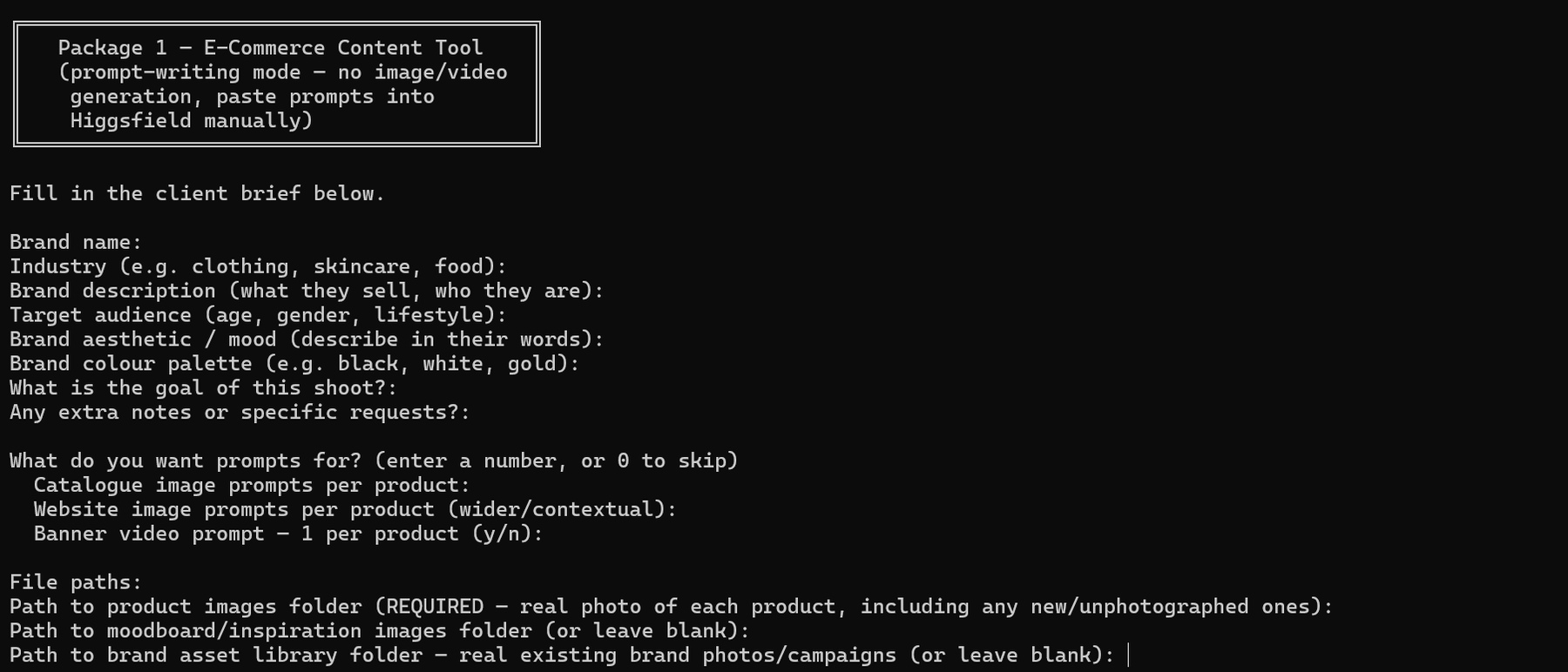
Python Terminal
Built in = 5 days
The Question
Can an AI production engine automatically understand any brand's creative identity and generate production-ready prompts without rebuilding the workflow every time?
The Challenge
While my Creative Production pipeline using Figma Weave successfully automated prompt generation, it wasn't easily reusable. Every new client required manually replacing visual guides, prompt assistants and creative references throughout the workflow. Although effective, the system was tightly coupled to a single brand and became increasingly difficult to scale. I wanted to design a production engine capable of understanding any brand through a simple creative brief, allowing the same system to adapt without rebuilding the workflow.
My Approach
Instead of embedding creative direction directly into the workflow, I designed a multi-agent engine that builds its understanding dynamically from a client brief. The system analyses three independent sources of information—product photography, creative moodboards and existing brand imagery—alongside structured information about the client, including their audience, aesthetic and campaign goals. This allows the same engine to adapt to entirely different brands without requiring the workflow itself to change.
System Design
Client Brief - Product Images Moodboard Brand Photography - Brand Analysis Agent - Product Analysis Agent - Prompt Writing Agents - Production-Ready Prompts - Higgsfield Image Generation
Process
- 01
Understanding Creative Production - Map how creative teams analyse brands, products and references before creating campaign imagery.
- 02
Designing the Agent Architecture - Break the workflow into specialised agents responsible for brand analysis, product understanding and prompt generation.
- 03
Building the Engine - Develop the Python application, integrate Claude's API and create structured prompt generation pipelines.
- 04
Refining Prompt Strategy - Experiment with different prompt structures to improve product accuracy, brand consistency and creative quality
- 05
Preparing for Scale - Organise outputs into reusable folders and design the system so future automation and additional agents can be added without redesigning the architecture.
Challenges
- —
Product Accuracy vs Creative Direction - Early versions relied on detailed text descriptions of products, but results remained inconsistent. I redesigned the engine to use uploaded product photography as the primary visual reference, allowing prompts to focus on atmosphere, lighting and brand identity while preserving product accuracy.
- —
Automation Constraints - The original architecture included a fourth agent that automatically submitted prompts to Higgsfield. API credit limitations meant this stage was temporarily replaced with manual submission while keeping the architecture ready for future integration.
- —
Generalising Beyond One Brand - Unlike my previous workflow, this engine needed to adapt to any brand without rebuilding the system. By analysing product photography, moodboards and brand imagery separately, the same architecture could generate unique outputs for different clients.
- —
Designing a Reusable AI System - The challenge wasn't simply generating prompts—it was designing a reusable engine that could understand any brand. By separating responsibilities across specialised agents and collecting familiar creative briefing inputs, the same architecture could adapt to different clients without rebuilding the workflow.
Final Outcome
I developed a reusable multi-agent AI production engine capable of adapting to entirely different brands through a structured creative brief rather than manually rebuilding prompt workflows. The system translates brand identity, creative references and product imagery into production-ready prompts while preserving human creative direction throughout the process.
Reflection
Building this project taught me that scalable AI systems aren't defined by how many prompts they generate—they're defined by how little needs to change between clients. Instead of designing another workflow for another brand, I shifted towards designing a reusable creative engine capable of understanding new brands through structured information alone. That change in thinking completely altered how I approach AI product design.
Future Improvements
- →
Build a client-facing web application that replaces the terminal interface with an intuitive frontend, allowing users to upload products, moodboards and brand assets through a streamlined creative briefing experience.
- →
Complete the fourth automation agent by integrating directly with the Higgsfield API, enabling end-to-end generation without manually copying prompts.
- →
Expand into three specialised production engines, with dedicated systems for e-commerce content, organic social content and full campaign generation.
- →
Introduce project management and asset libraries, enabling returning clients to save brand identities, creative references and previous campaigns for faster content production.